AI agents are moving closer to the buying decision. But customers aren’t handing over the control.
In early October, TikTok launched a Shopping Assistant that answers questions about products, sizing, delivery, and stock.
Alongside it came Agentic Leads, which qualifies potential customers through conversations, both on TikTok and on companies’ own websites.
So the question for product teams isn’t whether AI agents will talk to customers. It’s what they’ll say when they do.
Comparison comes before checkout
A new study from KPMG and the EHI Retail Institute shows where customers are right now.
73% of German consumers can imagine using an AI agent to compare products, prices, or offers. When buying a smartphone, 72% would let an agent search for information - but only 45% would let it handle the payment.
79% want to be able to step in at any time. And 67% want to know whether commercial interests influence the recommendations they get.
In other words, the first real market for AI agents is comparison, not autonomous checkout. Customers want help choosing. They still want to make the decision themselves.
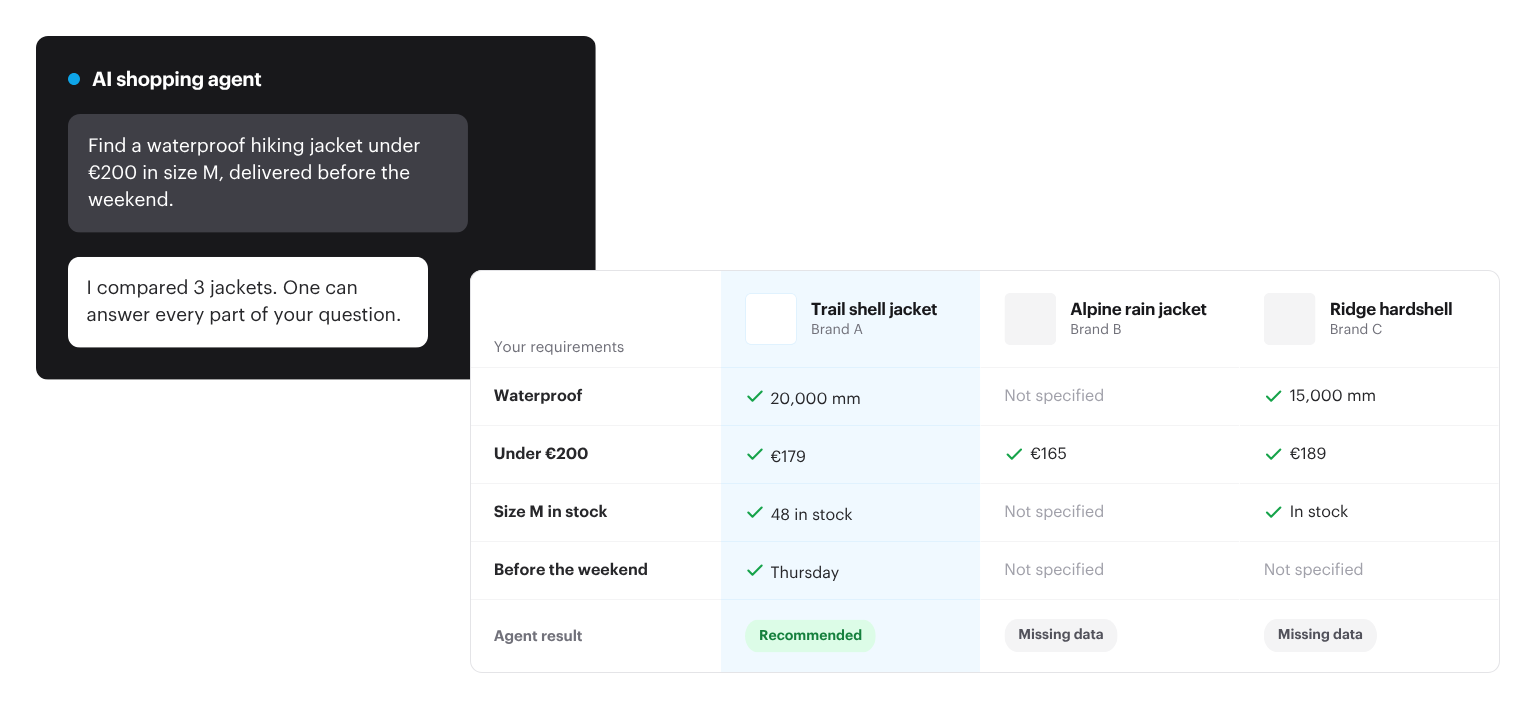
In B2C, the conversation is already happening. A shopper asks an agent for a waterproof hiking jacket under a certain budget, available in size M and delivered before the weekend.
The agent compares options across brands and recommends the ones whose product data can answer every part of that question.
For B2B companies, this is even more relevant. Before at customer ever talks to a sales rep, an AI may already have qualified the need.
It has asked which product fits the application, whether it works with the existing setup, and whether the documentation is in place.
The brands that get recommended are the ones whose product data can answer one simple question: which one fits?
From scattered knowledge to structured answers
A product page is built to present a product. A sales conversation is built to match a product to a need. That takes more than a description and a few images.
To answers with confidence, the agent needs:
- Product informations - specifications, dimensions, materials, and certifications
- Compatibility - what the product works with, replaces, or requires
- Availability and delivery - what can be shipped, where, and when
- Limitations - what the product is not suited for
- Documentations - datasheets, manuals, and declarations that back up the answer
For many companies, the knowledge already exists. It just isn’t structured.
It lives in supplier PDFs, in spreadsheets, and in the heads of experienced colleagues who knows which variant fits which application.
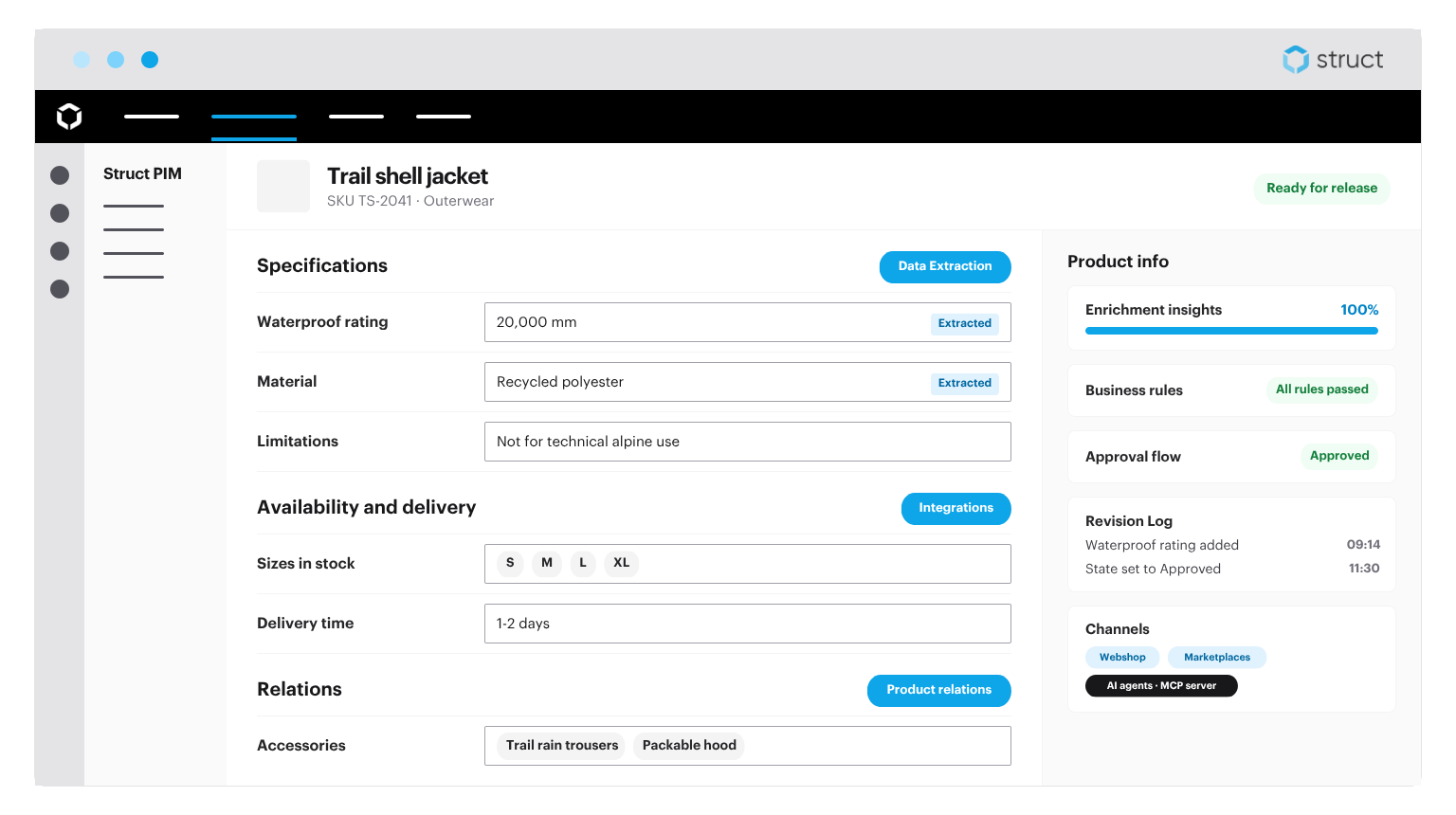
Struct PIM brings that knowledge into one place. With Data Extraction, teams can pull technical properties out of documents or websites and turn them into structured attributes.
Product relations make compatibility, accessories, and replacements explicit instead of implied.
And because the data model is flexible, it can reflect how your products actually work - not how a generic template assumes they do.
The result: knowledge that used to depend on one person’s experience becomes available in every channel - including the ones where an AI does the talking.
Trusted answers, in every channel
Customers want recommendations they can trust, and they look for them in many places. 64% prefer general AI tools when they want objective advice.
That changes the job for brands. Your product data needs to be reliable enough for any agent to use - whether it’s your own assistant, a marketplace, or a general AI tool your customers already use.
Trust starts with control. In Struct PIM, enrichment insights show which products are complete and ready for release.
Business rules validate data before it moves on.
Workflows and approval flows make sure the right people sign off on changes.
And Revision Log tracks every change, so you always know where an answer comes from.
Reach comes from distribution. Struct PIM delivers product data to webshops, marketplaces, and other channels through integrations and APIs.
With Struct PIM’s MCP server, AI tools can also work directly with structured product data in Struct PIM.
The result: AI agents become another channel, fed by the same product data your team builds, approves, and maintains every day.
Conclusion
AI agents will increasingly shape how customers discover and compare products. But for now, their role is clear: they help customers choose, but customers still make the final decision for now.
That puts product data at the center of the conversation. An agent can only recommend what it understands, and it can only explain what it can document.
With Struct PIM, teams can bring scattered product knowledge into one structured, governed source and share it with every channel where customers look for answers.
The companies that benefit won’t necessarily be the ones with their own agent. They’ll be the ones whose product data every agent can trust.
It’s not about owning the agent - it’s about owning the answer.