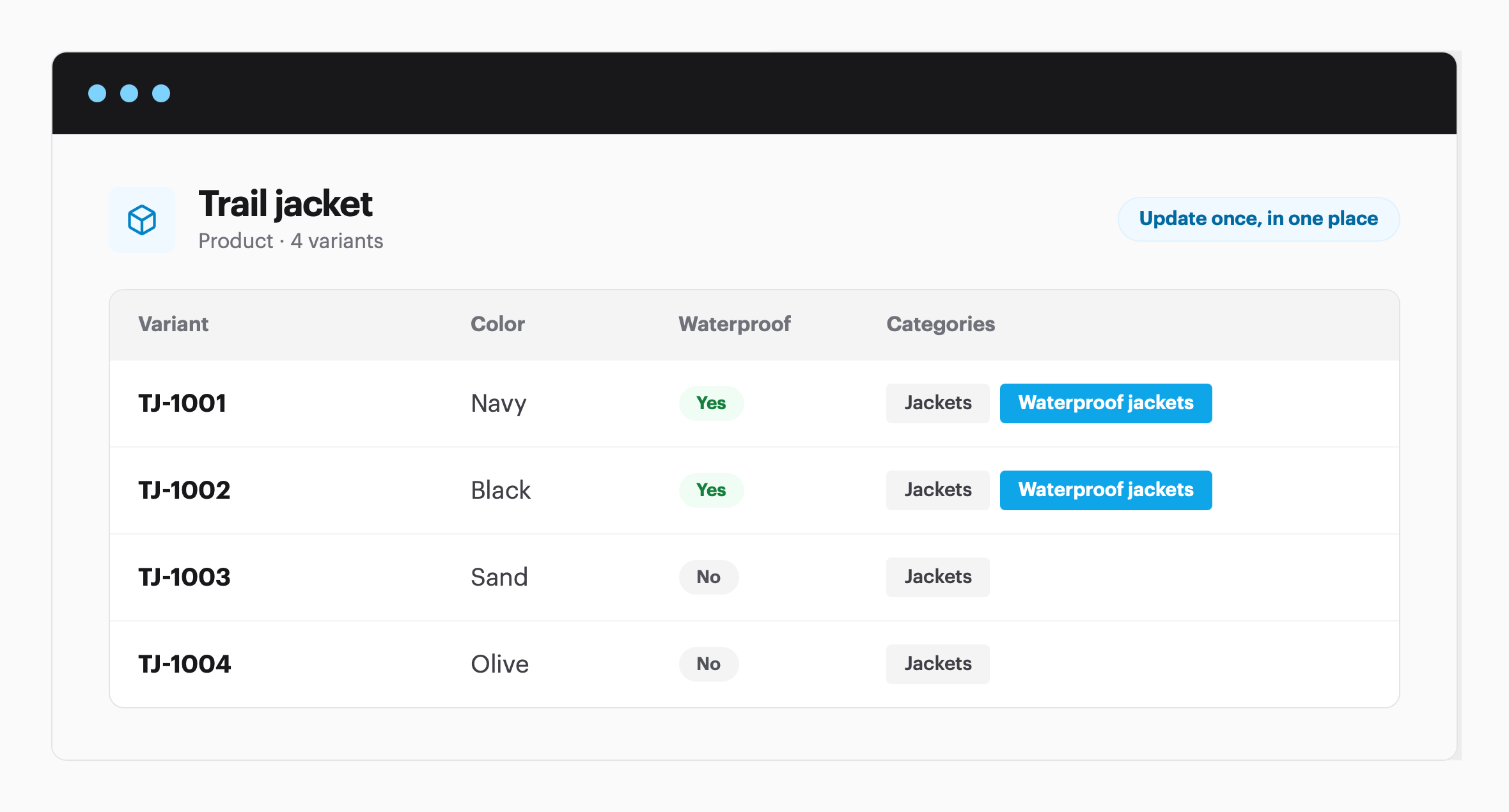
Not every variant belongs in the same category as its product.
A jacket might come in ten colors, but only some of them are waterproof. A component might come in several versions, but only some are certified for outdoor use.
The product is the same, but the variants have different properties, and that affects where they belong.
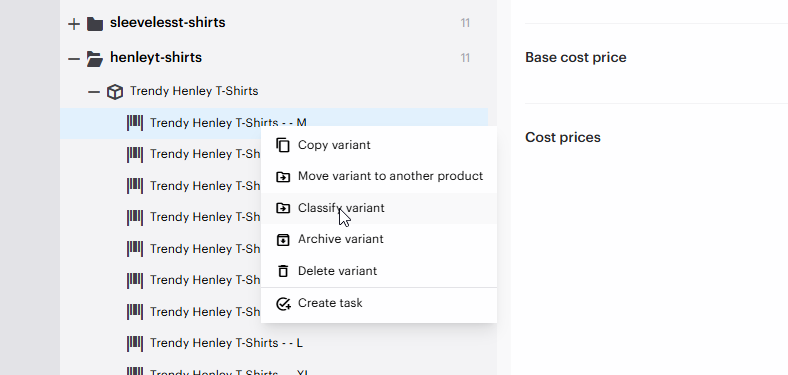
With the latest update to Struct PIM, you can now classify variants in categories directly, separate from their parent product.
That makes it possible to build category structures and assortments that reflect what each variant actually is.
When workarounds become part of the data model
Category structures are at the core of how product data is organized.
They define assortments, drive what goes to each channel, and help teams keep large catalogs manageable.
Until now, category fit has mostly been decided at product level. That works well when every variants shares the same properties.
But in many catalogs, the attributes that decided where something belongs - color, size, material, certification - live on the variant.
That leaves teams with two imperfect options.
Either they split one product into several product records to get the categories right, or they accept category structures that are less precise than the product range.
Both come at a cost. Splitting products means duplicated data and more maintenance. Less precise categories mean assortments that include variants that don’t really belong there.
How variant classification works
With variant classification, each variant can be placed in the categories that match its own attributes. The product stays one product. The variant goes where it actually belongs.
In B2C, that could be a sneaker available in several colors, where only some variants are made from recycled materials.
Those variants can be placed in a sustainability category, while the rest of the product stays in the general footwear category without creating separate products to make it work.
In B2B, it could be a cable that comes in several versions, where only some are rated for industrial use.
Those variants can go into an industrial installation category, while the rest of the product range stays where it is.
The result: Category structures and assortments that follow the actual properties of your variants.
More precise structures with less maintenance
For product teams, the biggest gain is that the data model no longer has to bend around the category structure.
You keep a single product record with its variants, instead of duplicating data to get the classifications right. When something changes, you update it in one place.
It also gives more control over assortments.
When categories can be assigned at variant level, it becomes easier to build assortments for specific channels, markets, or catalogs - based on the data you already maintain in Struct PIM.
That means less time spent on workarounds, and a category structure that stays accurate as the product range grows.